Case studies by crop · Permanent crops
Fruit fly baiting (Agras T40/T50)
DJI Agriculture case study, collected by FLYDROPS.
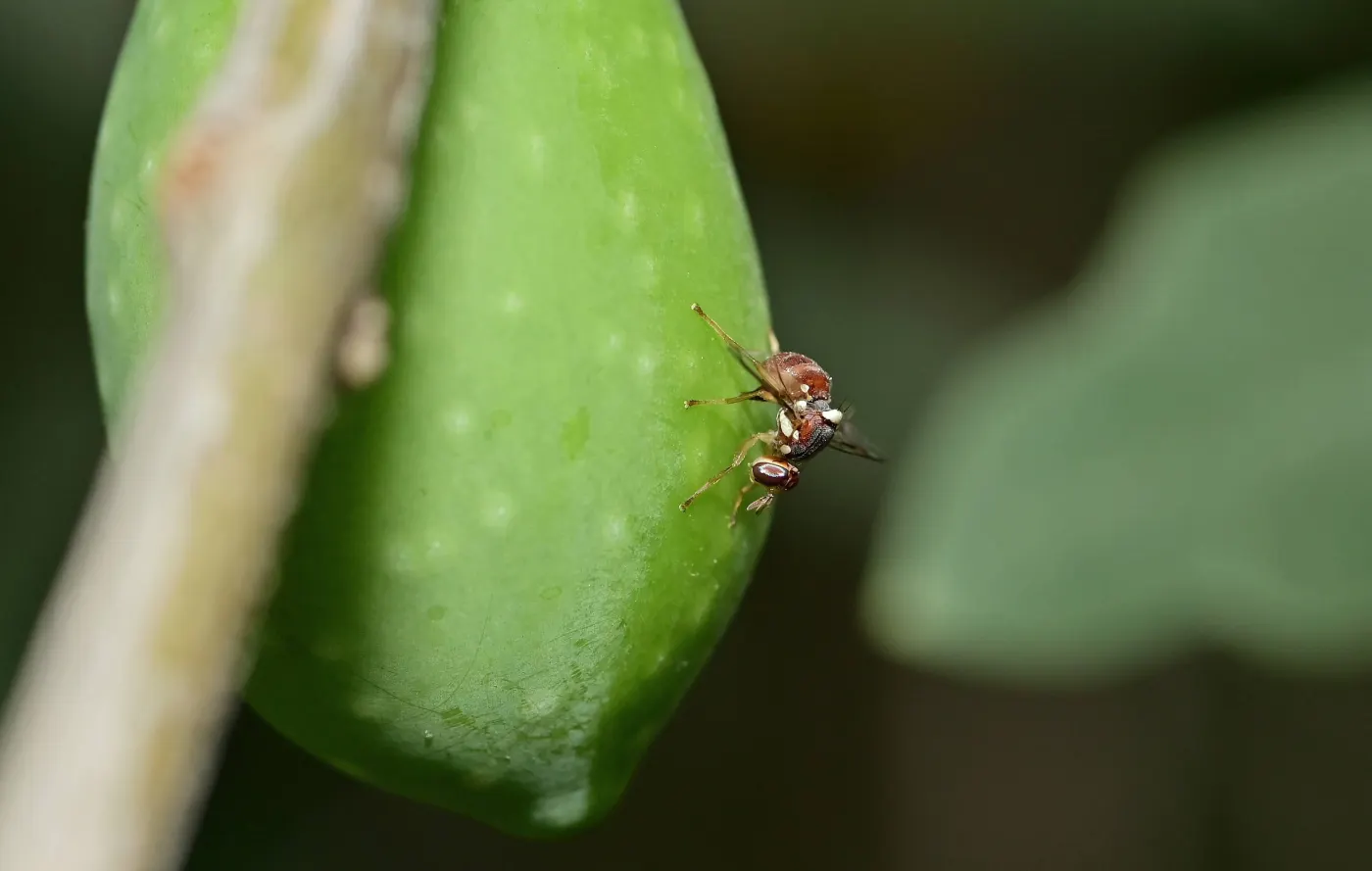
Fruit flies (Tephritidae) lay their eggs inside the fruit and threaten citrus, stone fruit, mango and more. In South Africa, where the application is repeated every 1–2 weeks, the Agras T40/T50 cover 120 hectares a day, against 50 by motorbike and 2 by hand.
At a glance
| Location | South Africa (information from 360° Drone Solutions) |
|---|---|
| Crop | Citrus (example), stone fruit, mango, pome fruit, berries, melons |
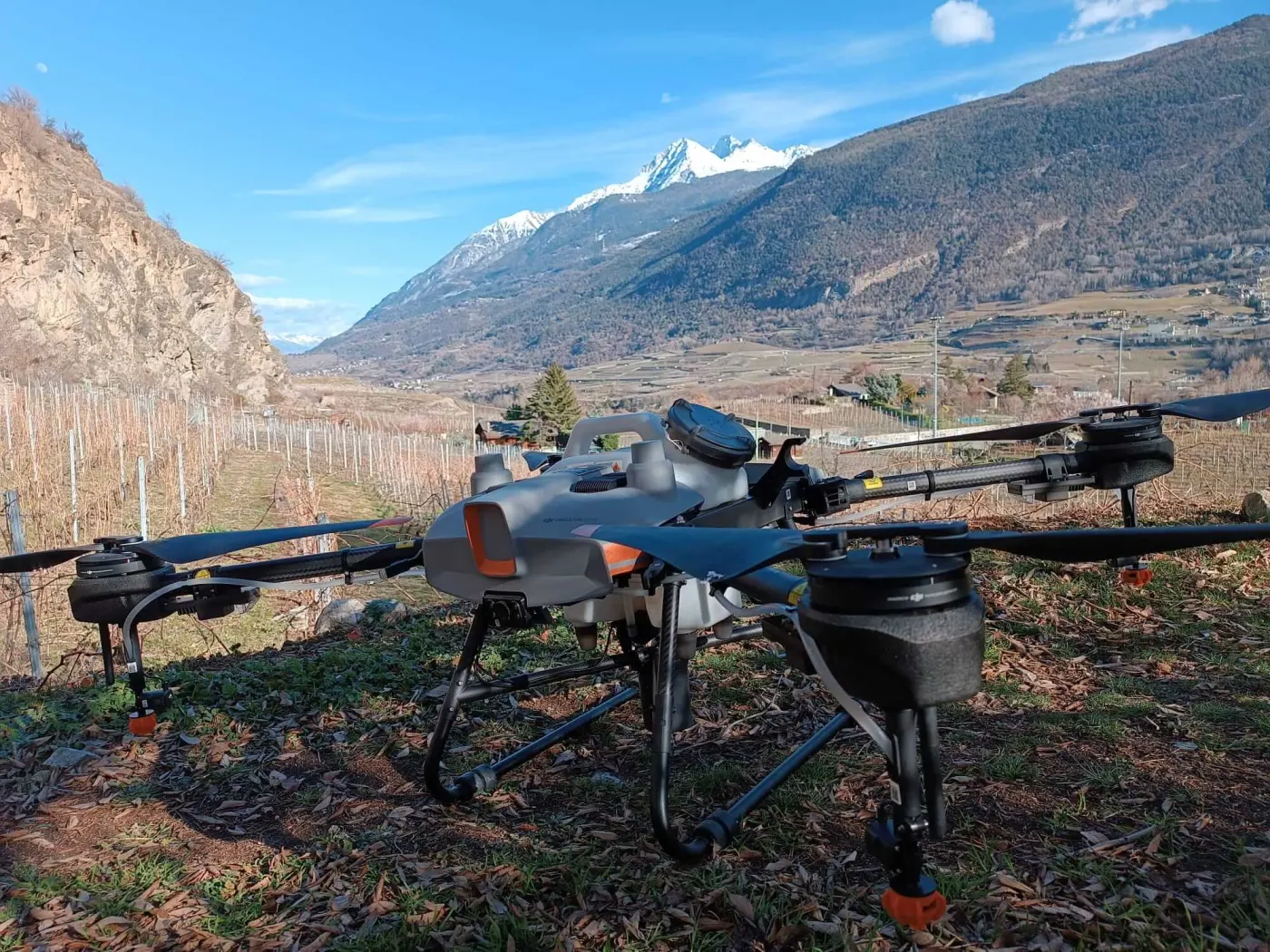
| Drone | DJI Agras T40 and T50 |
| Application | Protein bait, every 1–2 weeks in the fruiting season (up to 8 months) |
| Why it matters | Eggs found in export fruit can lead to long bans on sales |
The study uses the T40/T50, an earlier generation. The current range is DJI Agras T100, T70P, T55 and T25P; find which one fits your acreage or compare the models.
The challenge
The fly reduces the quality and value of the fruit and, in exports, a finding of eggs can close a market. Traditionally the bait is sprayed by hand or from motorbikes. Both methods have poor penetration, high cost and risk to the operator, and neither guarantees regular, timely coverage. After rain, motorbikes must wait for the ground to dry.
What was done
Because the bait attracts flies by the smell of protein, it does not need to cover all the foliage. The study’s recommendations for the T40/T50 are:
- total volume 2–4 L/ha,
- droplet size 500 µm (the maximum), for longer life and less evaporation,
- route spacing 12 m,
- height 8 m,
- speed 25–36 km/h,
- one application per week,
- temperature up to 30 °C and wind up to 15 km/h.
It also mentions modified nozzles for larger droplets, with a note that they are not covered by DJI’s warranty.
The results
| Measure | Agras T40/T50 | Motorbike | By hand |
|---|---|---|---|
| Daily coverage | 120 ha | 50 ha | 2 ha |
| Work-rate gain with drone | — | +140% | +590% |
| Water volume | 2–4 L/ha | 20 L/ha | Inaccurate |
The numbers come from the study and relate to that specific application.
Other advantages mentioned: operation on slopes of up to 50°, uniform coverage of the canopy and spraying right after rain, since the drone does not touch the ground.
What it means for Greece
In Greece the Mediterranean fruit fly (Ceratitis capitata), one of the Tephritidae, attacks citrus and stone fruit, and the bait method is well known. This study, however, is from South Africa, with a different regulatory framework. Here the rules for aerial applications apply (see below), as do the product instructions. The value for you is the logic of the application: settings, weather and frequency.
Rules and responsibilities
In Greece, applying plant protection products from the air, drones included, is prohibited as a rule and allowed only by derogation with a special permit. The study shows what happened in another country; it does not mean the same application is allowed in Greece. The product label always applies, and we do not repeat doses or products here. See the framework in the spraying drone buying guide and confirm it with the competent authority.
See also
- Orange trees and red mites with the Agras T16
- Peach trees and aphids with the Agras T20
- DJI Agras T55
- DJI Agras T100
Want to see what this means in your own field? Request a quote or call (+30) 2391 301149 and we will recommend the right setup.
DJI Agriculture case study, “Revolutionizing Fruit Fly Control with DJI Agriculture Drone Solutions” (15 July 2024). Translated and adapted by FLYDROPS. Results depend on the conditions of each field. Read the original.
See also
Application case studies by crop
Contact
Let’s talk about your fields.
Tell us what you grow and what you want to achieve. We’ll recommend the right equipment and send you a quote.